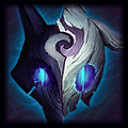
[THEORY] Interpretation of Kindred's tale...
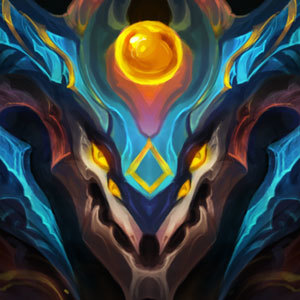
DISCLAIMER: I may be dead wrong about all of this, but it is food for thought.
Let's start off by examining the dialogue...
Lamb, tell me a story... There was once a pale man with dark hair who was very lonely... Why was it lonely? All things must meet this man, so they shunned him. Did he chase them all? He took an axe, and split himself in two... So he will always have a friend...? ...So he will always have a friend.
Now everybody's thinking, "oh yeah, Kindred is Death, but Death was lonely, so Death split itself to not be lonely". But let's take a closer look at the specific words used....
A pale man with dark hair.
Lamb is white (pale), Wolf is dark. Lamb is the body, Wolf is the hair. This explains why Lamb has an actual body, but Wolf is a trail of dark smoke following Lamb, the same way that long flowing hair would follow behind the person.
Why was it lonely?
IT. Why would Wolf ask about "IT", instead of "HE"? Because Wolf is asking about the hair, and understands that Lamb is calling the hair lonely, not the man. Wolf was lonely. But Wolf sees hair as a thing. An "it". Lamb saw the hair as a person, a being. A "who". The question now is whether the Hair could communicate with the Man/Body? This does suggest that the Hair (Wolf) was conscious and experienced loneliness.
All things must meet this man, so they shunned him.
Everybody is jumping on the idea of "all things must meet death", and nobody likes death, so they shun it. As in, death of living things, with living things actively shunning the pale man. What else could it be? Not all things are living... But all things END. They MEET an ending. Lamb, the pale man, is symbolic (somehow) of things ending. How can "all things" take an action (shun), if they do not exist? The very existence of "all things" that do exist right now, defy an ending, they shun an end. Unless that ending is life. We'll touch on that later.
Did he chase them all?
Honestly, this line trips me up pretty hard. What can we extrapolate though? We know all things end, and can end in different ways. As such, things that have not yet ended, are pursued by an end.
He took an axe, and split himself in two
The pale man cut off his own hair. If this body-hair analogy works, it seems that Lamb was aware that Wolf was alone the whole time, conscious and hurting. And so Lamb made this conscious decision to cut his Hair.
So he will always have a friend...?
Interesting that Wolf jumps to this. This further reinforces the idea that it is Wolf that was lonely. Wolf having experienced loneliness for so long and gaining a newfound friendship, would suggest that Wolf feels empathy for others, or has a mind that is more inclined toward perceiving the relationship between things. This line also suggests that the man (Lamb) wanted a friend, but not out of loneliness. Rather, out of good heart and pity for the Hair (Wolf).
...So he will always have a friend.
Lamb affirms Wolf's suspicion. Lamb wanted to befriend Wolf, and in a way confides to Wolf, "I will always be there for you. You will never be alone again"
But what about the whole "Kindred is the concept of ending, rather than death"? Kindred is an agent of outcome. Wolf is ravenous and represents the death of things, which is one type of ending. Lamb is benevolent and represents the life of things, which is one type of ending.
Consider this in the context of League, without regard for the balance of Kindred's abilities. Wolf partakes purely in offensive abilities, or damaging other things. Lamb partakes in both offensive and defensive abilities, and can bring death or prevent it. Lamb marks someone who could die next, but Lamb also controls who could live next.
Lamb can carry out his role of controlling outcome on his own, bringing either death or life. Lamb being the primary body is supported by how Lamb is the one telling the story to Wolf, with Wolf asking questions. But Lamb chooses to have Wolf at his side, a companion, working towards a common goal. His own Hair that he cut off.
Even if I'm totally wrong on what Kindred represents, I'm dead-set on believing that Lamb, the pale man, befriended Wolf, the hair, to gain a companion and to relieve Wolf of loneliness, by separating the hair from the body.
Follow-up questions for the lore: 1.) How far does Kindred's power reach? Is Kindred a "god" in the sense of controlling outcome, or more like Bard, a mortal entity that brings great power to local areas?
2.) Does Kindred's symbolism of outcome only affect living things, or does that extend to inanimate or intangible things, such as stories/lore, thoughts, language, etc.?