A question with no answer?
The answer is not as simple as it first appears.
The answer is not as simple as it first appears.
 LANWhale5 votes
Hm....or perhaps...
An answer with no question.
 Laughing Fish2 votesLANWhale1 votes
Whats the matter? Having a WHALE of a problem there, bud?
 InvalidGuest4 votes
Yes
 Narasimha4 votes
Doctor... Who?
Laughing Fish3 votesSilence will fall.
 Sozan53 votes
It's an old and known paradox. You are late like 20 years - it wasn't THAT known back then.
Laughing Fish4 votesYou must be great at parties. "Happy birthday!" "Thanks, but you are about 20 years late. My real birthday was in 1995"
Sozan52 votes[{quoted}](name=Laughing Fish,realm=NA,application-id=Ir7ZrJjF,discussion-id=Yse2G5dn,comment-id=00010000,timestamp=2015-01-08T00:13:02.262+0000)
You must be great at parties. "Happy birthday!" "Thanks, but you are about 20 years late. My real birthday was in 1995"
Still, you couldn't have chosen anything more known than this one... Maybe with exception of "this sentence is false".
 Vauren3 votes
None of the above? It's a 33% chance because there is in essence three answers.
...But then again, there are 4 buttons and two of them are the same, so if the doubled answer is correct, then it's a 50% chance. BUT if it's wrong, then It goes back to a 25% chance.
So 33% of the time we have a 50% chance, and then 66% of the time we have a 25% chance. Let's take these rules into a test of 100 trials, where 33/100 times we have a 50% chance and the other 67 there's a 25% chance of being correct.
33 x .5 = 16.5 67 x .25 = 16.75 16.5 + 16.75 = 33.25
So we take the 33.25 times we were correct over the 100 trials, and we get 33.25/100 which is basically 33% chance of being correct in a perfect math world.
This is all assuming one of the three options is correct while the others are wrong of course. The way I went about this might be completely wrong too, I'm no probability guru.
 DREADN0UGHT1 votes
You, I like you.
 Mozi Godsend2 votes
It seems pretty easy but maybe im missing something. i guess 50 but so far im the only one :3
Laughing Fish2 votesYes, but if you 50% is the right answer, and there is only a 25% chance of randomly choosing 50%....
 BallisticMouse1 votes
This is an old paradox, there is no correct answer.
Therefore stupid thread. gg.
 elafante21 votes
Your odds of being correct are 0% since the question has no current answer.
This updates the answer to 0%, which isn't displayed as answer, keeping the question impossible to answer if only allowed to chose the given answers. This means the odds are still 0% (impossible).
 2000boxes1 votes
the answer to this problem is 100%
there is no defined answer so you can't be wrong
if you aren't wrong then you are right
Laughing Fish1 votesBut you are also not right. And if you are not right, are you not wrong?
 SlimyDan1 votes
None of the above? It's a 33% chance because there is in essence three answers.
...But then again, there are 4 buttons and two of them are the same, so if the doubled answer is correct, then it's a 50% chance. BUT if it's wrong, then It goes back to a 25% chance.
So 33% of the time we have a 50% chance, and then 66% of the time we have a 25% chance. Let's take these rules into a test of 100 trials, where 33/100 times we have a 50% chance and the other 67 there's a 25% chance of being correct.
33 x .5 = 16.5 67 x .25 = 16.75 16.5 + 16.75 = 33.25
So we take the 33.25 times we were correct over the 100 trials, and we get 33.25/100 which is basically 33% chance of being correct in a perfect math world.
This is all assuming one of the three options is correct while the others are wrong of course. The way I went about this might be completely wrong too, I'm no probability guru.
I don't think you can simply put both of the 25% answers together like that, say for example I had 99 trillion options that all have the answer 25% expcet for the 50% and 60%. In that scenario it is very easy to imagine that it is likely that the person will select 25% so when you think about it you cannot put the 2 25%'s into 1 25% because that would imply that the chance of choosing 25% is no more likely than the other 2 options when it actually is more likely.
I think the answer answer to the question is actually 0% because all the other options would result in a paradox
 Embertine1 votes
There is a fifty percent chance of me being Right or being wrong here. As there are four options, and thus I would have a 1 in 4, or 25% chance to be correct.
HOWEVER!
As two of the options are both 25%, this means that either one I picked would still yield a 25% chance of being correct, while allowing me to choose either one and to maintain the same odds. This means that these two options are in fact one in the same, and give me exactly 25% chance each, would instead yield a 50% chance of being correct, as they both would be either correct or incorrect at the same time.
Thus I in fact have 50% chance to be correct. And I can then choose option 2, which is the 50% option, as it will both cover it's own chances and also the chances of both of the 25% options as well.
Thus I have a 50% chance to be correct in my choice.
Laughing Fish1 votesHowever, you only have a 25% chance of choosing 50% at random.
Embertine1 votesDam I forgot that I had to choose at random. Well that leaves me with an actual 75% chance that I will get the correct answer at random, as I can either get 25%, 50%, or 25%, which is 75% of the options. Thus I will in fact have a 75% chance that I will choose correctly, even at random.
However!
75% is not one of the answers and thus cannot be used. While also there is a 60% percent option which CLEARLY has been overlooked.
While I am not a mathematical wizard, the contradiction that both the 25% chances and the 50% chance present, leads me to believe that they are wrong. Which leaves the only option left as the correct one. Thus I in fact have a 60% chance to be correct. (It might actually be 66% but again I am no mathematical wizard)
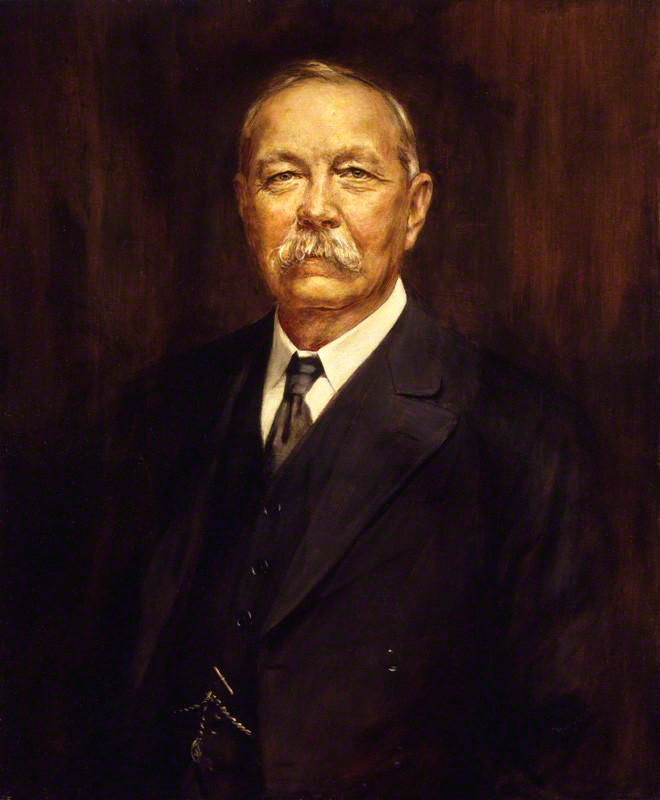
After all, “Once you eliminate the impossible, whatever remains, no matter how improbable, must be the truth.”
http://www.victorianweb.org/painting/portraits/arthurconandoyle.jpg