[Diamond Design] How Passive Should a Passive Be?

Hello everyone!
Glad to see most people seemed to enjoy my previous article, so we’re going to have another discussion. Let me know if the series title is something I should change and if you have any better ideas. In the same vein, if you have any suggestions for topics you want me to discuss, please let me know in the comments.
I’m going to try and keep these coming on a weekly basis, probably posting on Sundays, so stay tuned! But of course, no promises. I’m doing this because I like you guys and think these topics are interesting, but unfortunately they don’t pay my bills. Anyway, time to get started. Today’s topic is…
#How Passive Should a Passive Be?
This week’s discussion follows the concept of last week’s and expands on it, this time looking more specifically at champion passives. Quick refresher, we talked about interesting decisions in a kit, and how having too many or too few can be problematic in terms of balance. We talked exclusively about abilities, so this talks about something we didn’t focus on at all. What makes a passive interesting? What makes it good? Should it be something that just sits on the sidelines or something you should really have to think about?
What a ridiculous question! By far the best passives in the game add gameplay and decisions to their champions rather than just give them free stats. Other things passives shouldn’t do is eat up significant portions of a champion’s invisible power budget, and they DEFINITELY shouldn’t be something you can effectively ignore at higher levels of play.
In the rest of this article I’ll examine a number of similar passives through classic showdowns, and explain why I consider one of them to be better designed than the other. I will not be discussing whether I think the rest of their kit is good or bad, or whether a champion is strong or weak.
#Applying Effects on Spells
http://ddragon.leagueoflegends.com/cdn/img/champion/splash/Brand_4.jpg
Brand vs Kennen
In the red corner! The Man on Fire! The Human Torch! The Burning Vengeance! BRAND!
- Blaze: Brand's spells light his targets ablaze, dealing 8% of their maximum Health in magic damage over 4 seconds.
In the blue corner! The Lightning Mouse! Speedy Gonzales! The Heart of the Tempest! KENNEN!
- Mark of the Storm: Kennen's abilities add a Mark of the Storm to its target for 6.25 seconds. Upon receiving 3 Marks of the Storm, an opponent is stunned for 1 second and Kennen gains 25 Energy. The stun has a diminished effect if it occurs again within 7 seconds.
Any guesses as to which one of these is the better designed passive? Come on, it’s a 50-50 chance just go for it. Well?
If you guessed Kennen, you’d be right!
“Oh man this guy’s so dumb. Brand’s passive sets up his other abilities to do different cool things! I’m not gonna read the rest of the discussion!”
Ouch, that was a quick decision to stop reading! You’d be right in saying the thing about Brand though, but you’re forgetting an important aspect of Brand’s kit. The passive itself is only the damage over time to champions, and the all the cool things his abilities do to enemies marked by his passive are actually passives on the other abilities.
Both of these champions have passives that are applied to enemies through the use of their spells. Looking at their passives in pseudo-isolation, Kennen adds Marks of the Storm to his opponents, and by managing the marks he has on his enemies, he can make important decisions as to whether he wants to activate the stun, which targets to try and activate the stun on, and gives him a strong incentive to try and manage his passive in such a way that allows him to gain maximum benefit from the stun and energy return. Without looking at the rest of his kit, one could assume that a defining part of his kit would be to try and proc this stun onto as many targets as possible in a short amount of time.
Looking at Brand however, his passive is a lot of extra damage that is only somewhat earned. The problem with Brand’s passive is primarily this: if Brand’s passive didn’t do damage, he would still have a nearly identical play pattern. Hit the target with a spell so that his other spells can have more fun effects. Another problem is that there is almost zero counterplay to Brand’s passive when compared to Kennen’s. The player could choose to back off and ensure Kennen does not get the third mark when he’s hit, but the same player cannot back off from the damage that Brand deals with his passive. I would go so far as to say that because of how much damage his passive does naturally, Brand will likely never see buffs beyond quality of life improvements, as he has received no buffs since patch 3.9, in July 2013 (apart from the extra armor all champions received in 4.5).
Both players still face the same dilemma of simply getting tagged again when they return to the fray.
Alright so we have this problem, what options are there to fix it? I don’t have definite answers as to what could be done to fix the problem, but simply other options. I’m also not a Rioter, so don’t expect anything to come from anything said here.
Keep the cool effects that the spells have if the target is previously marked, but have the burn do damage as a percentage of his Ability Power instead of the target’s maximum health. This limits the obnoxious playstyle of support Brand, which can do damage comparable to a standard mid laner without the pesky part of buying damage items, while at the same time maintaining the core of his gameplay, comboing spells!
#Post Death Actions
http://ddragon.leagueoflegends.com/cdn/img/champion/splash/Sion_4.jpg
Sion vs Zyra and Kog’maw
That’s right folks, this matchup is actually a 1v2! Sion, the Undead Juggernaut, faces his biggest challenge yet as he takes on the Mouth of the Abyss and the Rise of the Thorns! Let’s take a look at what they’re all bringing to the table!
- Glory in Death: After being killed, Sion will reanimate himself with rapidly decaying Health. He can move and attack during this time. He gains 100% Lifesteal, attacks extremely fast and will deal an additional 10% of his target's maximum Health as physical damage on hit. Max 75 bonus damage against monsters. All of his abilities are replaced with Death Surge, which grants him a burst of Movement Speed.
- Icathian Surprise: Upon dying, Kog'Maw starts a chain reaction in his body which causes him to move faster and detonate after 4 seconds; dealing 100 + (25 x lvl) true damage to surrounding enemies.
- Rise of the Thorns: When Zyra dies, she briefly returns to her plant form. After 2 seconds, she can press any ability to fire a thorn toward her cursor, dealing true damage to each enemy it strikes.
These passives are all at least conceptually similar. After you die, you have a chance to retaliate against your opponent, and maybe bring them down with you. However, Sion’s passive is far superior in a design space than either Kog’Maw or Zyra for two reasons.
First is the options it presents for your opponent to play with. Sion’s passive allows him to quickly move towards a target and damage it while his health deteriorates. This first gives Sion a number of options. Do I want to target the enemy I was chasing/running from? Do I want to help secure an objective? Do I want to just use it farm? At the same time, it gives his opponents options as well. Do I run from it? Do I kill it? Do I ignore it? Depending on the situation, all of these can be important options. By using crowd control on undead Sion, you vastly limit the usefulness of the passive. However that same CC could be used on a champion trying to escape.
The options available to Kog’Maw and Zyra when they die are much more simplistic. Aim/run towards my opponent, or sometimes farm, and hope to do enough damage to ensure that target(s) dies. Kog’Maw’s passive is actually the worse of the two because of the movement speed boost he gains during it, making it more difficult for other champions to get away without using an escape ability. Zyra has to aim and gives the opponent the ability to try and outwit their opponents and dodge correctly. Overall these abilities can either be attempted to escape from, or simply taking them.
The second reason is the playstyle of the champions. Sion, a tanky initiator, is expected to dive into the middle of the enemy team and control the movements of the enemy team. This will mean he is often surrounded and killed. This is a playstyle that would be true even without his passive. Being able to continue making decisions after he’s dead is a natural continuation of his playstyle.
Zyra and Kog’Maw on the other hand are long range dps. Neither of them want to be in a situation where they will ever have an opponent on top of them. This means that if they are doing their job correctly, they effectively do not have a passive! The situation where these characters want to die so that they can finish off their opponent that they couldn’t otherwise kill effectively never happens, and instead their passive functions as a consolation prize of sorts.
What passives do other low-mobility, high damage, long range champions have? Jinx has a reset mechanic that allows her to have high temporary mobility. Ziggs has an enhanced auto-attack that comes with spell rotations. Vel’Koz has true damage when he lands multiple spells in rotation. An option similar to these would be good options for these characters. Perhaps, after casting or landing a certain number of spells, Zyra’s next autoattack is a snow/snare? If Kog’Maw gets a kill or assist on the last champion to damage him, he gets enhanced movement speed? While not perfect solutions, they at least complement what their playstyles already are.
#Auto Attack Enhancements
http://ddragon.leagueoflegends.com/cdn/img/champion/splash/Caitlyn_5.jpg
Caitlyn vs Corki
In the next competition, we have a battle between marksmen. She holds up the law, Caitlyn, the Sherriff of Piltover! He zooms around the sky in his ROFL Copter, Corki, the Daring Bombardier!
- Headshot: Every few basic attacks, Caitlyn will fire a headshot dealing 150% damage to a champion or 250% damage to a minion.
- Hextech Shrapnel Shells: Corki's basic attacks deal bonus true damage to minions, monsters, and champions.
Looking at Corki and Caitlyn’s passives, they fulfill a somewhat similar role, making their autoattacks more impactful. However, Caitlyn’s is much better designed, because it creates decisions in her kit and for her opponents when playing. Caitlyn has to build up her passive, autoattacking targets to get access to a little bit of extra damage. Corki on the other hand just has slightly extra damage on his autoattacks. With the slight power spike she receives when she has access to headshot, it gives her a little extra power to play with, and good Caitlyn players will try and use this extra damage to try and get a little advantage in lane by using that damage on an enemy player rather than a champion. Similarly, there’s even ways to slightly optimize access to her headshot by autoattacking from a bush rather than simply in lane.
Meanwhile Corki just does a little more damage than he would otherwise. Why is this a problem and what I consider a symptom of a poor design choice? There are no situations in which this passive incentivizes you to make a different decision than you would without it. Would you still autoattack your opponent in this situation? The answer is universally yes! There is no depth added to the character.
What could be done instead? Corki has a playstyle that already incentivizes alternating spells and autoattacks in a fairly simple rotation. To further encourage this, we could perhaps alter Corki’s passive such that every spell you land on an enemy champion marks them for a couple seconds. Autoattacking that champion would do a percentage of his damage as true damage to that target. This incentivizes a playstyle he already enjoys while giving an extra layer of decision making to his kit.
#Spellvamp
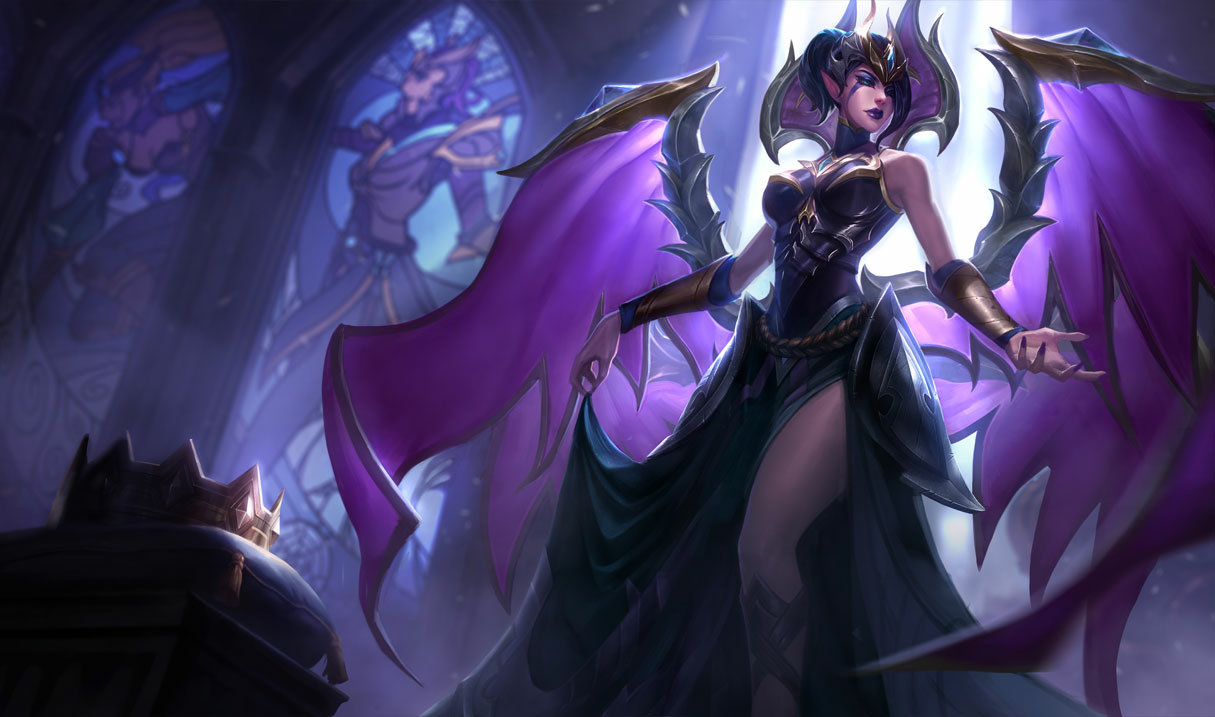
http://ddragon.leagueoflegends.com/cdn/img/champion/splash/Morgana_6.jpg
Alright you’ve suffered through enough of my bad jokes for commentating, and this one is a fairly simple topic. Morgana vs Ahri.
- Essence Theft: Gains a charge of Essence Theft whenever a spell hits an enemy (max: 3 charges per spell). Upon reaching 9 charges, Ahri's next spell heals her whenever it hits an enemy.
- Soul Siphon: Morgana has Spell Vamp, healing herself whenever she deals damage with her spells.
Again, on the surface, these two passives are fairly similar. Both provide a means for these champions to sustain themselves through the lane. Can you guess which one I think is better designed?
It’s Ahri’s of course! Every time you want to make use of Ahri’s passive you make a minimum of four decisions, even if they are usually not particularly interesting. Stacking the passive through casting on the wave or hitting your opponent are often decisions that don’t necessarily overlap. Similarly, in situations where you’re fighting your opponent it can be an important decision to try and optimize damage compared to your own sustain.
Morgana’s passive adds very little to her gameplay. What options do we have to fix it? What if her spellvamp was only available after a certain number of spellcasts, or damaging enemy champions? This would allow each time she used her spell vamp to be more satisfying while adding some small decision points to her kit.
A pair of champions who have a similar situation are Mao’kai and Nasus. Mao’kai gets a percentage of his health back when autoattacking after a certain number of spells are cast in his vicinity. Nasus simply gets percentage lifesteal. Both passives succeed at giving the champions sustain in lane or when jungling, but one of them has the option of trading mana for health conditionally, while the other just has extra sustain.
#Autoattack Passives on Casters
There is one general group of passives that don’t contribute to a champion’s natural playstyle from their kit that I think are still good design, because they present incentives for the player to break what is otherwise a non-interactive, low counterplay playstyle. Orianna, Ziggs, Xerath, and Lux all have champions that incentivize the target to autoattack their opponent, for various reasons. They all normally have playstyles that would want (or allow) them to be as far away from their opponent as possible and still easily farm up. However, because they get extra damage or mana from their passives, they are able to create situations where autoattacking, and thus coming within reasonable ranges, is actually a good decision. By breaking the playstyle they otherwise have by giving them close range passives, these champions become much less aggravating to play against.
#Objective Creation
Zac and Thresh are other examples of passives that are excellent in terms of the decisions and play that come up with their kit. They create mini-objectives and decisions to make in lane, souls and bloblets, which both you and opponent want to either take or deny from your opponent. By making new points of contention they add decision making to the game.
#Extra Stats
These passives do not add any meaningful decisions to the game, and lack real points of mastery related to their kit. Instead they just make the character stronger with no real tradeoffs. Big offenders of this, Shyvana, Wukong, Irelia, Heimerdinger, and Kassadin limit a lot of what their champion could potentially do. The problem is that there are ways to give characters more stats with points of mastery, or making the player earn the stats. Examples of this include Jax, Graves, Varus, and Vayne. They have extra stats built into their kit, but they have to earn them, or they are only available in limited situations.
So what things make passives good or bad? Based on the examples we’ve seen above, there are some basic criteria to look at and ask yourself when considering the design of a champion.
- Does this passive make the player make different decisions than they normally would?
- Does this passive encourage a playstyle this champion already has? OR does this passive encourage less frustrating playstyles?
- Is this passive extra stats? Is it free stats or does the player have to earn them?
Based on these answers, it then becomes fairly straightforward to determine which passives are good for the game and which ones ought to be reworked or retouched. Of course, once again, I focused on topics that felt more natural to talk about. There are many passives that resist easy categorization (Gnar, Quinn, and LeBlanc). Some of them are well designed, others are not. Some of them have a good base for expansion of the passive, others should be completely scrapped. Go ahead and dig deeper into them and respond with your thoughts. Of course, if you want a place to start...
FOOD FOR THOUGHT: Which passive shield is best designed? Yasuo, Mordekaiser, or Vi?
I hope you enjoyed this discussion on passives! Please let me know what you thought in the comments and if you have ideas as to what I should talk about leave a message. There’s a poll below on some of the topics I’ve considered writing about, let me know if any of them seem interesting to you. While I don’t promise the top result will be written about, it will definitely be a factor in my decision making.
Thanks for reading everyone and have a good week!







 and
and  's revives.